Tuesday, August 17, 2010

Images and Podcasts

Images in the classroom
Images are a very important tool in the classroom for the beginning reader. When texts are complicated and uninspiring students rely on the pictures to form connections and meaning with the words. Images are also effective tools for engaging students and enhancing participation in new units of work.

This image would immediately inspire most students to engage in discussions on the topic of recycling by associating their own experiences with the meaning portrayed by the words and the image.
The image uses colours, a cartoon character and a catchy phrase to capture an audiences attention. 

This next image has no words but uses arrows and pictures to engage an audience. This could be used to support more in depth discussions which would require students to use higher levels of thinking.

Podcasts

 My podcast 
http://judij59.podomatic.com/entry/2010-08-24T16_47_28-07_00
I am still experimenting with how to get this to upload into my blog. Not easy being a ditigal immigrant.
A podcast is a portable technology that can be listened to anywhere and anytime as it is similar to a radio program. Podcasts are used for a variety of teaching and learning purposes as well as for personal use.  A wide range of podcasts can be downloaded for free using iTunes and there are lots of different materials to choose from including nature programs, exercise music, lessons in speaking Japanese, personal growth podcasts. 
 This is my podcast url/ address. I found podomatic troublesome to use but then being a digital immigrant my knowledge of this technology is limited.

I would need a lot more practise with this tool before I could use it effectively.  I can see how students in higher education would find this tool beneficial especially for university students who are trying to combine work and study and may at times be unble to attend lectures.
Educational Benefits
  • effective tool for engaging students who learn by listening
  • lectures and can be broadcast and listened to anytime and any place.
  • Students would enjoy listening to themselves
Challenges
  •  studies have shown there is little evidence of either positive or negative effects on student outcomes
  • concerns that students in higher school education will not show up for classes and lectures
  • is considered to encourage passive learning by some researchers
More information can be found on the website below
http://sydney.edu.au/science/uniserve_science/images/content/2009_papers/elliot1.pdf
Elliot, E., King, S., & S. Scutter, S. ( 2009). To Podcast or to not Podcast:Pedagogical decision making in the use of new technologies. Retrieved 23rd August, from:
http://sydney.edu.au/science/uniserve_science/images/content/2009_papers/elliot1.pdf

Monday, July 26, 2010

Wiki's and Weeblies

Wiki's to promote a collaborative and interactive classroom

Wiki’s are different to blogs in that a wiki might take one person to initially create an article but multitudes of people can contribute to and work on that single piece of content so one article may have lots of authors whereas in a blog an article usually only has one author but comments pertaining to that article can be contributed by others.

Wiki's are described as being an appealing and fun way to engage students in learning activities. They are considered ideal because they encourage student participation, collaboration and interaction, after viewing the 21st Century Learning video I would have to strongly agree with that description.

Some important aspects to think about in terms of 21st Century Learning using wiki's include:

Educational Benefits
  • promotes learning through collaborative authoring
  • higher level thinking skills are developed through critiquing other students work
  • investigative skills are further developed when work is critiqued and additional research is required
  • encourages creativity
  • develops teamwork and conflict management skills
  • class communities are built through collaborative learning

 Classroom uses:   
  • group projects
  • collaborative textbooks
  • assignments
  • collective writing, 
  • research projects, 
  • data collection, 
  • organization of projects
Challenges
  • know and follow school policies and procedures
  • use a psuedonym
  • obtain parental permission
  • appropiateness of materials 

     
    Swot Analysis of a Weebly


    The features of the weebly website seem similar to googlesite and it's editing features are more refined than blogspot

    Strengths:  
    •    directions are clear and simple to follow for setting up the website
    •   basic technical knowledge
    •  easy drag and drop features 
    • pages can be easily organised
    •  customising and adding content is done by double-clicking and dragging.
    Weaknesses:
    • haven’t come up with any yet
    Opportunities:
    •     creative learning resource for teachers and students
    •   reflective learning tool
    •    evaluation tool
    Threats
    •   safety and security of personal information 
    • appropriate material content

    References
    Wikibooks. (2010, August 5). Change Issues in Curriculum and Instruction/Wiki's in theclassroom. Retrieved August 17, 2010, from Wikibooks, the open-content textbooks collection

    http://en.wikibooks.org/wiki/Change_Issues_in_Curriculum_and_Instruction/Wikis_in_the_Classroom

    About.com. (What is a Wiki? Wikis Explained: Understanding Wiki, Retrieved August 17, 2010 from About.com
    http://webtrends.about.com/od/wiki/a/what_is_a_wiki.htm

    Thursday, July 22, 2010

    Learning Design Framework


    Engagement Theory
    This theory is a technology-based learning and teaching framework. It uses a constructivist approach to teaching and learning and emphasizes collaborative teamwork where students are involved in creating projects that are relevant to real world contexts. The 3 components of the Engagement theory  Relate, Create and Donate assist in the development of cognitive processes which are important to developing interpersonal relationships at home, school and work later on.

    Educational Benefits
    • suitable for most learning abilities
    • technology-based/ problem based
    • focus is on collaborative teamwork
    • all students have the opportunity to succeed in learning
    • authentic learning context enhances student motivation and satisfaction
    • develops communication, planning, management and social skills 
    • develops cognitive processes; decision making, creating, problem solving, reasoning and evaluation.
    Digital tools such as emailing, webconferencing, blogs, wikis and chat programs all require collaborative efforts to source and process information. This course Managing e-learning requires students to build websites, follow blogs and post comments, highlighting the fundamental idea behind the Engagement Theory that students engage in learning activities that are creative, meaningful and authentic.


    References
    Kearsely, G ., Schneiderman, B. Engagement Theory: A framework for technology-based teaching and learning, Retrieved July 19, 2010, from:
    http://home.sprynet.com/%7Egkearsley/engage.htm

    McInerney, D., & McInerney, V. (2006). Educational Psychology, Constructed Learning, French Forest, NSW, Australia: Pearson

    Monday, July 19, 2010

    Blogs

    Setting up a blogspot
    How I envy all of you digital natives out there. My experience so far is that I am way too slow at getting my thoughts creatively organised into a blog that I am happy to publish, however, I am enjoying the experience of this new online learning environment and I can see how students could engage positively with learning tasks this way. 

    So, what is a blog? A blog is like a journal or a diary only it is created using the internet. Setting up a blog can be done by signing up to a website such as www.blogger.com

    Blogs allow people to share different types of information for various purposes. Personal blogs might include sharing photos of holidays or weddings. Other blogs focus on specific topics such as music, art, environmental issues or current affairs.
    Although blogs are usually written in a quick informal style bloggers aim their writing at a target audience.

    Educational benefits:
    • interesting and fun way for students and teachers to communicate and collaborate with each other.
    • promotes an interactive approach to learning more so than the traditional chalk and talk method.
    • engages students positively in learning tasks.
    • valuable reflective learning tool
    • blogs can be edited to include new learnings.
     Classroom use:

    • exchange knowledge, expertise and experiences; to share ideas, stories, music and art.
    • for personal use as an online diary or journal.
    • for educational purposes for teachers and students.
     Challenges: 
    • safety and security of personal information and identity
    • school policies and procedures for blogging should be adhered to.
    • parental consent should be obtained.
    • students need to be trained in issues regarding access, privacy, security and netiquette.
    • content in blogs may not be factual and should be recognised as the opinion of the student.
    The link below addresses the following topics of interest about blogging for educational purposes it also feaatures some examples of student blogs.
    • educational value of blogs
    • classroom and teacher applications
    http://www.det.wa.edu.au/education/cmis/eval/curriculum/ict/weblogs/


    References

    Crie, M. (2006). Using Blogs to Integrate Technology in the Classroom. New York, America: Glencoe/ McGraw-Hill. 
    http://www.glencoe.com/sec/teachingtoday/educationupclose.phtml/47

    Teachers First Home. (2007). Blog Basics for the Classroom. Retrieved August 17, 2010, from:
    http://www.teachersfirst.com/content/blog/blogbasics.cfm


    Sunday, July 18, 2010

    Concept Maps

    Creating a concept map: 
    This example of a concept map was created using the online website http://bubbl.us/
    I found this to be time consuming but effective for organising information simplistically.

    The concept of how mind maps work is explained in
    Tony Buzan's mind mapping video where he refers to concept maps as a thinking tool which reflect externally what goes on in our heads and, how thinking and memory can be enhanced by using imagination and association with words, pictures and branches. For visual learners concept maps would enhance most students' abilities to absorb and retain new information. Concept maps elaborate new learnings by chunking and linking information in a simplistic way and are are considered to be an invaluable tool for teaching.  This chunking provides students with the ability to understand and make links between different pieces of information and to remember that information more effectively. It also enables students to access and clarify their understandings more efficiently. (McInerney & McInerney, 2006)

    Benefits
    :
    • facilitates learning and recall
    • clarifies similarities between concepts

    Classroom uses:
    • for comparison activities
    • generalisation/principle patterns 
    • cause-effect patterns
    • organisational patterns

    Challenges:
    • students require indepth training before skills are developed proficiently
    • concept relationships can be oversimplified and important information can be left out.
    References
    Marzano, R. J., & Pickering, D. J. (1997). Dimensions of Learning, Teacher's Manual.
    (2nd ed)Aurora, Colorado: McRel.

    McInerney, D.M., & McInerney, V. (2006). Educational Psychology, Construct Learning.(4th ed) French Forest, NSW, Australia: Pearson.


    Wednesday, July 14, 2010

    Active Learning

    Knowing your learner

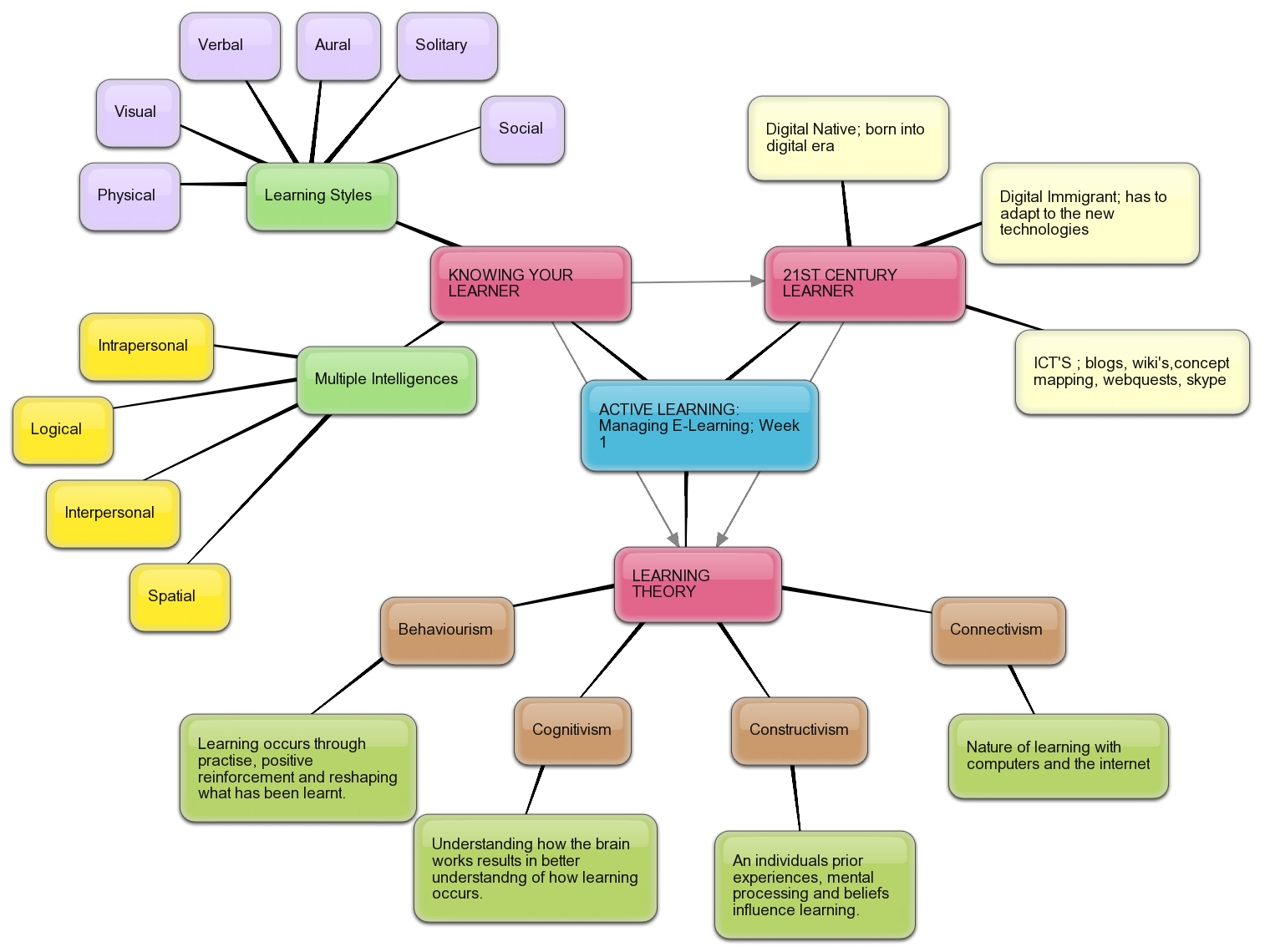
    When considering our own previous learning experiences we can relate to the need to reflect on how successful we were at school in order to understand how we as future learning managers can best ensure the learning success of our students.

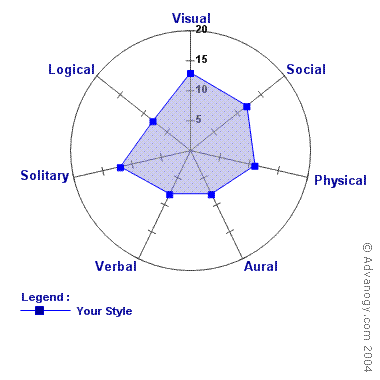
    The combination of prior experiences, prior knowledge, positive attitudes and perceptions all influence our ability to become successful learners. When we understand the learning styles of different students we can then implement strategies to support and enhance those needs. Marsh (2005) considers that it is crucial for teachers to match their styles with students' learning styles so that they can be more responsive to the individual needs of students.

    Learning Style
    s: My results indicate that I am a hands on learner, I need to make and do. Visual representations such as diagrams and drawings help me to consolidate new learning and I also benefit from verbal instruction and demonstration to absorb new information.

    Multiple Intelligences: Howard Gardner's research infers that a broad range of talents within schools provide many opportunities for students to excel in particular those students who are often considered unexceptional or at risk of failing. He considers that curriculum designed around the eight intelligences gives students the opportunity to discover their weaknesses and strengths and to develop a full range of intelligences. Knowing how to build on those weaknesses and enhance strengths will contribute to more successful learning.

    So this takes me to the new experience of writing my first blog. Although I feel I have taken some time to find my way about, I am happy that my background looks jazzy although I might change it yet, just having fun at the moment. I can see how blogging would be of benefit to teachers with resources, lessons and homework being able to be posted as a blog. Parents also have the opportunity to keep up-to-date with class happenings. Seems a great way for all stakeholders to collaborate.

    Thanks to anyone who takes the time to read through all of this. I'm unsure of how much actually goes into an individual blog and also how informal or formal it needs to be. I would enjoy hearing any feedback on any aspects of this blog.

    References.
    Marsh, C. (2005) Teaching Studies of Society and Environment. (4th ed.), French Forest: NSW: Pearson Education Australia.
    McInerney, M., & McInerney, V. (2006.) Education Psychology: Constuct LearningFrench Forest.NSW: Pearson Education Australia

    New to blogging

    Hello everyone,
    It is exciting but somewhat daunting to be studying using blogging but what a great opportunity to connect with learning using this form of technology. Being a very mature aged student I feel some trepidation towards unfamilar processes or methods of learning. Blogging as a learning method certainly ensures that the student participates in the active learning process. I look forward to looking back and wondering why I was somewhat anxious about it all. Hope you all enjoy the journey of E-learning.
    regards
    Judy